Day 2: May 23, 2013
Ugh. I get so overwhelmed trying to write about busy days like this - but I have to, otherwise I will not remember it when it comes time to make a photo book!
The next few days of our vacation were pretty packed full of sightseeing. Well pretty much up until the time that we left - we were going, going, going.
We decided to walk the Freedom Trail around Boston today. Would you believe I didn't take one photo of the actual Freedom Trail?! It's a red line that is painted all around the city, guiding you to all of the different historical sites. In some places, they even had red bricks running down the center of a cement sidewalk to help people know where to go. It was madness. I couldn't believe how much time they put into it, but pretty awesome nonetheless.
You can walk the Freedom Trail on your own, or you can pay for a tour. Mike being the history lover he is decided he wanted a tour. I think it was probably worth it, Mike thinks it was totally worth it and would tell anyone who visits to get a tour of some sort. It's just nice to get stories or facts that you wouldn't have otherwise known about the people who lived there and the events that took place.
We started at the Boston Commons with our tour guide who apparently lived during the time of the revolution. That made for some interesting stories ;)
Then we headed to the Park Street Church and the Granary Burying Ground (South Burying Ground):
We were able to see James Otis' grave.
- They used to have something called Writs of Assistance in colonial Boston. Basically if you complained about someone, they gave you a search warrant that you could use the rest of your life to go in and search their house - and you could take whatever you wanted. You didn't have to have any proof they did anything, you just had to complain. James Otis is famous for arguing against this writ for five hours in Superior Court. Only one member of the court stayed awake for the entire argument, John Adams.
- James Otis graduated Harvard Law and was talented in his arguments. One evening James went to a coffee house where John Robinson, a man James had commissioned against, also sat. A fight broke out and Robinson struck him with his cane. James Otis ended up with a hole in his head, the worse head injury the doctor had seen to have the victim still living. Our tour guide said that later, when James Otis was pushed around town in his wheelchair, kids would run behind and try to throw pennies into the hole. James Otis suffered from mental disease or insanity.
- James Otis told his sister Mercy Otis Warren, "My dear sister, I
hope, when God Almighty in his righteaous providence shall take me out
of time into eternity that it will be by a flash of lightning."
He
was later struck twice by lightning, the first time he survived and the
second time while visiting a friend, he stood in the doorway during a
storm and was struck dying instantly. *Be careful what you wish for.*
- John Hancock was the first and only signer of the Declaration of Independence on July 4, 1776. The rest of the delegates signed several weeks later.
- Hancock’s signature was so large that to this day, the slang expression for your “signature” is “your John Hancock.”
- John Hancock was very pompous and prideful. He thought that he should be Commander and Chief in the war but George Washington was chosen instead. Washington went on to be President of the United States and John Hancock was mayor at the time. Because of his jealousy towards Washington, he didn't announce when President Washington was coming to Boston; the President arrived to Boston with no welcome or parade as would have normally taken place at that time.
The graves used to be strewn around across the cemetery - no order and definitely not in lines; everyone was just buried wherever. When they decided to stop letting sheep eat down the grass and began using lawn mowers, the graves were moved and organized into straight lines:
If you could afford a table-type grave/headstone - it was the best way to be buried. Since people hadn't started donating their bodies to science, medical students had to find a different way to get bodies... GRAVE ROBBING! They normally couldn't move the larger graves, and so the people buried under them could rest assured that their bodies would lay safe and sound.
Approximately 5000 people are buried at Granary Burying Ground even though there are only 2300 headstones. Since funerals were expensive, there would be one headstone per family. Each grave contains at least 20 bodies.
All of the 'famous' people that are buried in the Granary Burying Ground didn't have huge, wonderful headstones placed immediately upon their death. In fact, this is Paul Revere's initial headstone:
However, at one point visitors weren't allowed in the burying ground so they had to stand at the street and look in at the graves. So the city made larger, 'more grand' headstones for these people, so that guests could see their 'graves' (even though they aren't buried where their headstones are located) from the street. These include headstones of Paul Revere, Sam Adams, James Otis, John Hancock, the five victims of the Boston Massacre, and Benjamin Franklin (not the Ben Franklin you are thinking of - he is buried in Philadelphia but was born in Boston).
In fact, Paul Revere wouldn't have had a large headstone at all because he wasn't really famous until after he passed away and the poem "Paul Revere's Ride" was written about him (by Henry Wadsworth Longfellow).
Crazy size difference of Paul Revere's original and new headstone right?!:
While there is no evidence to prove that this is in fact Mother Goose's headstone, it is a Boston legend that Mother Goose is buried in the Granary Burying Ground.
According to Eleanor Early, a Boston travel and history writer of the 1930s and '40s, the original Mother Goose was a real person who lived in Boston in the 1660s. She was reportedly the second wife of Isaac Goose, who brought to the marriage six children of her own to add to Isaac's ten. After Isaac died, Elizabeth went to live with her eldest daughter, who had married Thomas Fleet, a publisher who lived on Pudding Lane. According to Early, "Mother Goose" used to sing songs and ditties to her grandchildren all day, and other children swarmed to hear them. Finally, her son-in-law gathered her jingles together and printed them. (Wikipedia)
Mike really liked the portion of the legend that the tour guide shared
in saying that Mother Goose's son in law never liked or enjoyed her
singing.
 |
| "HERE LYES Y BODY OF MARY GOOSE WIFE TO ISAAC GOOSE, AGED 42 YEARS DEC OCTOBER Y 19th 1690" |
I kind of have a thing for looking at old graves. These next few pictures explain why, check out the tombstone art:
This one is the most common picture found on the headstones - it reads Momento Mori - Latin for "Remember That You Will Die."
This picture of two skeletons waiting at an hourglass (center) was pretty awesome:
Also, this image of the skeleton trying to beat time by getting to the hourglass fast enough is pretty unique and awesome as well:
The Samuel Adams headstone:
Samuel Adams is known for the beer - the Samuel Adams beer - but did you know that Samuel Adams didn't drink?
-
A strong opponent of British taxation, Adams helped organize resistance in Boston to Britain's Stamp Act of 1765. He also played a vital role in organizing the Boston Tea Party—an act of opposition to the Tea Act of 1773—among various other political efforts.
The headstone of the five victims of the Boston Massacre and one young boy, who was in the wrong place at the wrong time weeks earlier:
Christopher Snider is considered to be the first martyr to the cause of the American Revolution. He was twelve years old at the time; Loyalist, Ebenezer Richardson, had attempted to destroy the effigy, and a mob gathered around his house, throwing rocks and attempting to wreck his house. Richardson fired several shots at random from his window and Christopher Snider was killed.
His death was overshadowed two weeks later when the Boston Massacre occurred so when they created this headstone, Christopher Snider's name was added.
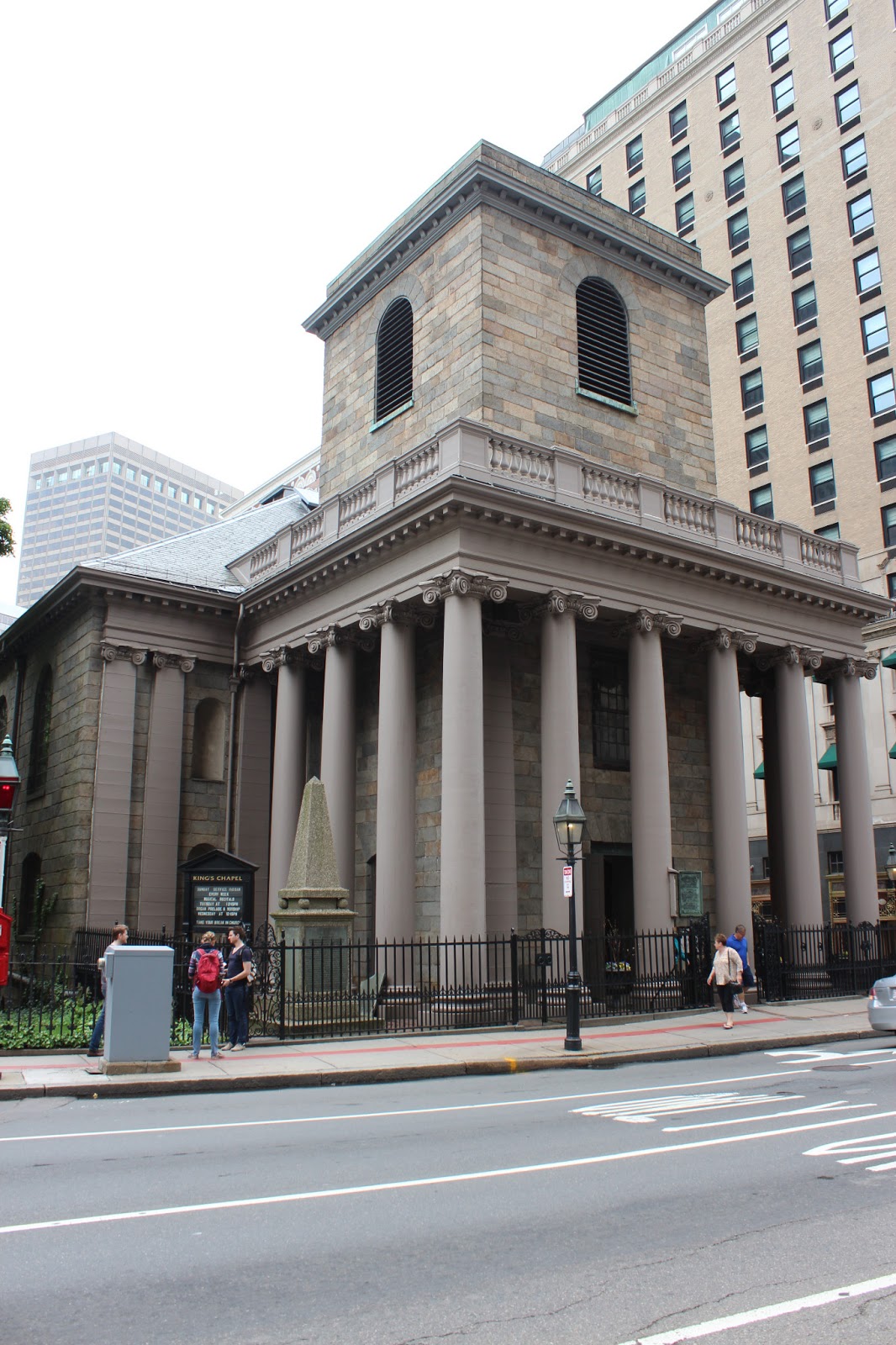
King's Chapel
The original King's Chapel was a wooden church built in 1686 by orders of the King of England by a man named Sir Edmund Andros. Sir Edmund Andros was to find a place and build an Anglican church but nobody in Boston would give or sell land to him to build a non-Calvinist church; because of this, Sir Edmund Andros built the church on public ground, a cemetery. It is now known as the King's Chapel burying ground but at one time was the only burying ground in all of Boston. It was the only burying ground from 1630-1659, then in 1659 the Copp's Hill Burying Ground was formed, a year later, the Granary Burying Ground was formed.
The church was built on top of half of the graves in the cemetery. The townspeople in Boston were very upset because they did not want an Anglican church built atop the graves. When the American Revolution began all the Loyalists fled to Canada and the church was left vacant. In 1754 stone was placed around the original wood church.
Old State House
Photos above and below show the Old State House and the buildings surrounding it. At one point, the Old State House was the tallest building in all of Boston.
Citizens
often gathered around the State House balcony (shown below) to hear the reading of
official proclamations, many which were of great historical
significance. It was also from a spot underneath this balcony that the
famous Boston Massacre began. Here, a handful of angry British soldiers
fired into a shouting crowd of Boston citizens, killing 5 of them. There
is a circle of paving stones underneath the balcony which marks the
historic occasion.
On
July 18, 1776, the citizens of Boston first heard the words of the
Declaration of Independence, read from atop this balcony. Later that
day, symbols of royal authority (the gold unicorn and lion) that once
graced the State House were burned.
Faneuil Hall:
Faneuil Hall has served as a marketplace and a meeting hall since 1742. Funding was provided by a wealthy merchant, Peter Faneuil, for the construction.
The first floor was built to be a market house, the second floor was build to be an assembly room. Inspirational speeches by Samuel Adams, James Otis and other patriots were given at Faneuil Hall. These oratories became the footstool for America's desire to obtain independence from the British.
If you look close, there are scribbles along the pavement surrounding Faneuil Hall. The Boston Harbor Shore Line used to go up to this point, which means that Faneuil Hall would have been built in the ocean. Big ocean ships would port 10 feet behind where Faneuil Hall now sits; the location was known as Dock Square. Peter Faneuil had to fill the land before building the Hall.
The Ebenezer Hancock House was built in 1767 and is the only remaining house in Boston associated with John Hancock. He owned the house but it was lived in by his brother. This house is one of the few downtown residences surviving from the late 18th century.
These pictures (above and below) are the streets of Boston back in the day. They are the original size of Boston streets back in the day. All other streets have been expanded to fit at least two cars.
Climbing the Bunker Hill Monument:
 |
294 Steps to the top.
Baby girl sure was having a hay day in my belly after the climb. |
|
|
Views of Boston from the top:
Oh goodness! We saw, we ate, and we did so much more - but I think that's all I care to document about for now!




 On our walk home from Harvard Square, the rain started coming
down hard! So we ducked into a café for some hot chocolate. Mmmmm – not only
very pretty but very delicious. Mike has some expensive taste in hot chocolate.
He wanted to get it multiple times a day every day that we were out there.
On our walk home from Harvard Square, the rain started coming
down hard! So we ducked into a café for some hot chocolate. Mmmmm – not only
very pretty but very delicious. Mike has some expensive taste in hot chocolate.
He wanted to get it multiple times a day every day that we were out there.


.JPG)
.JPG)
.JPG)